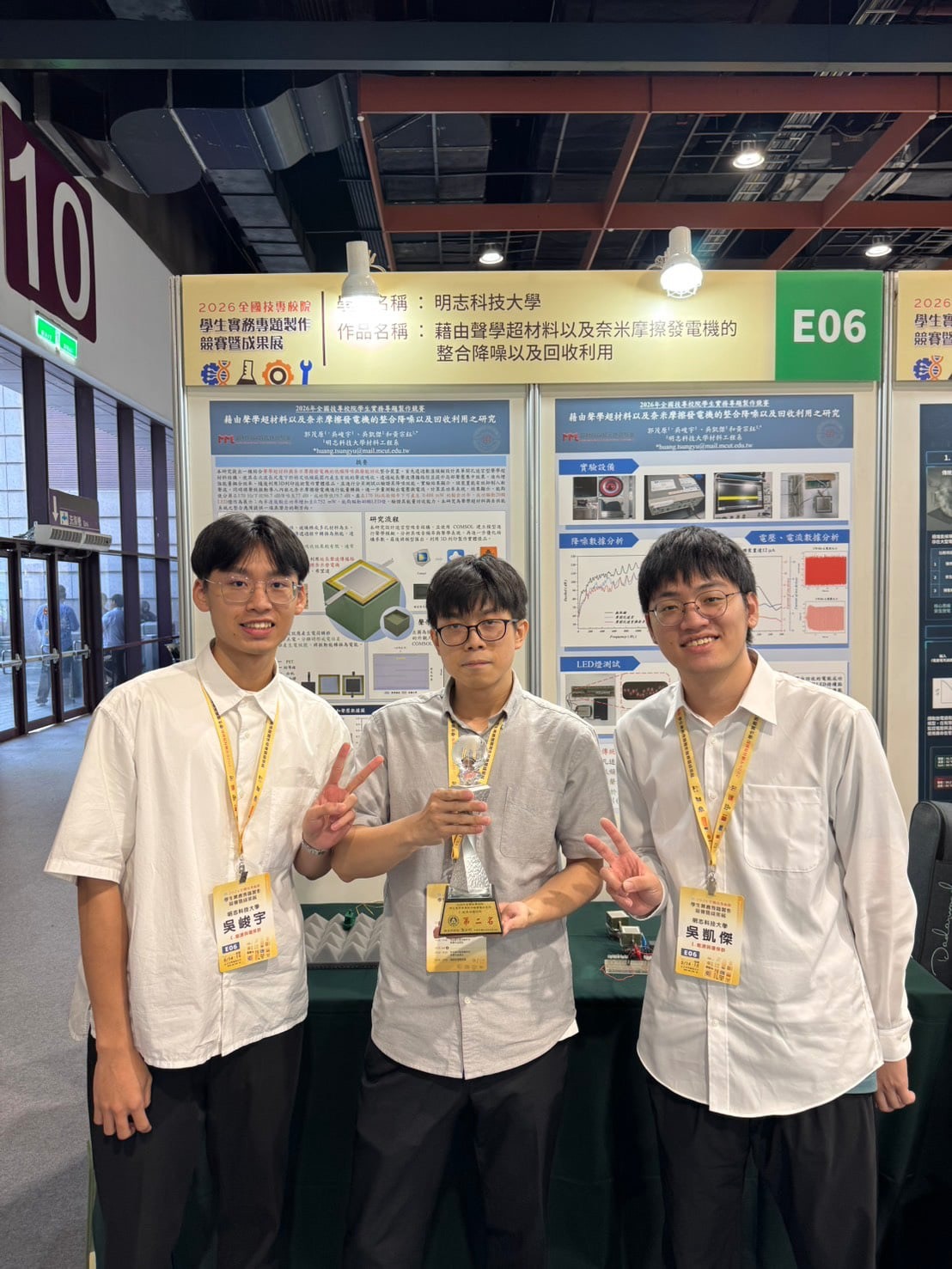
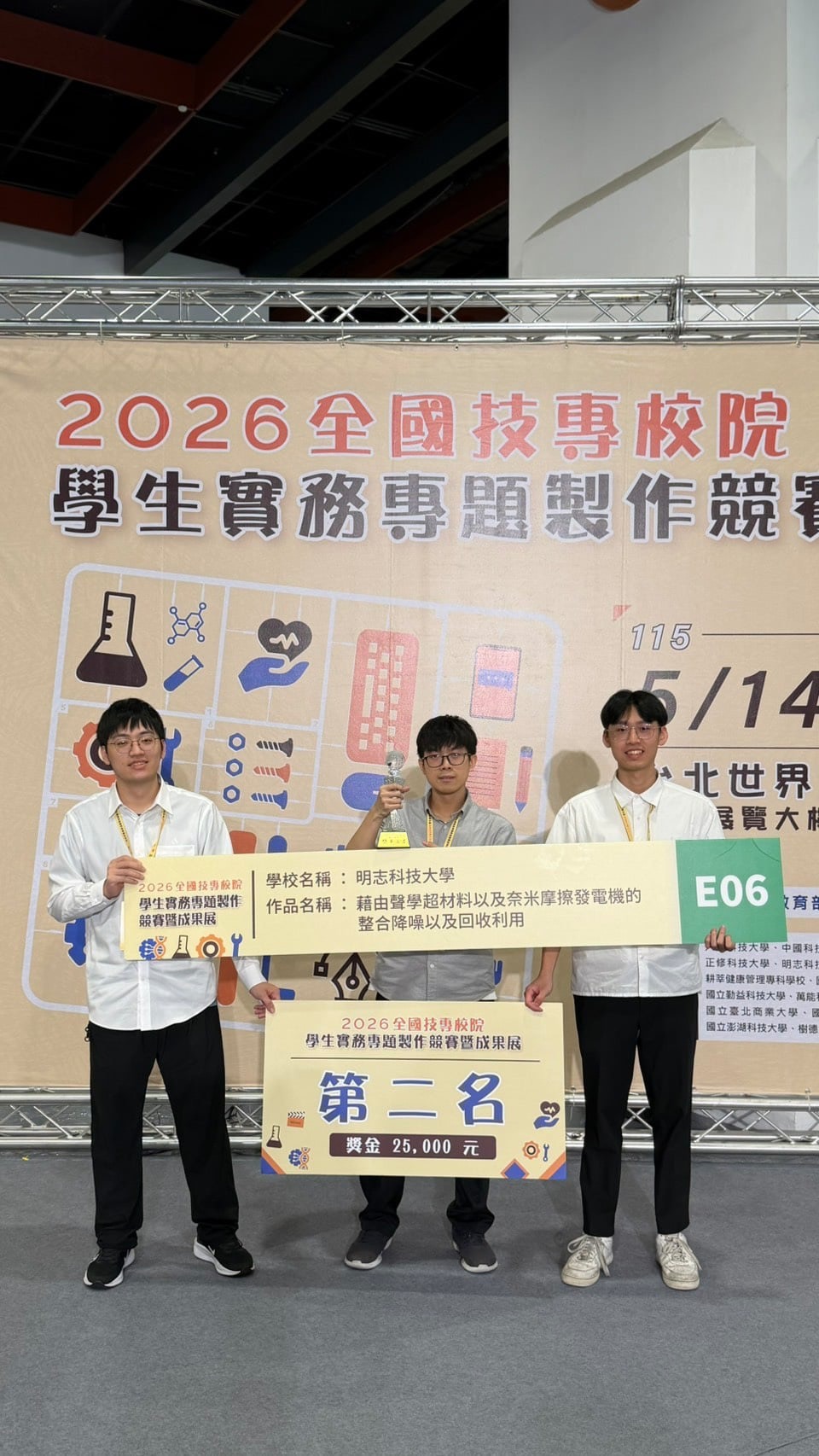
Congratulations! Students supervised by Professor Tsung-Yu Huang won Second Place in the Energy and Environmental Protection Category (Category E) at the 2026 National Competition of Student Practical Projects for Technical and Vocational Colleges.
Our team participated in the 2026 National Competition and Exhibition of Student Practical Projects for Technical and Vocational Colleges in the Energy and Environmental Protection Category with the project titled "Research on Noise Reduction and Energy Harvesting through the Integration of Acoustic Metamaterials and Triboelectric Nanogenerators (TENGs)," and was honored to receive Second Place. We are deeply honored and encouraged by this achievement.
This project focuses on low-frequency noise reduction and acoustic energy harvesting. To address the limitations of conventional sound-absorbing materials, which often require considerable thickness and installation space for effective low-frequency noise attenuation, we proposed an integrated design combining acoustic metamaterials with triboelectric nanogenerators (TENGs). This research not only demonstrates the application potential of low-frequency sound wave control but also converts previously underutilized acoustic vibration energy in the environment into electrical energy, enabling the system to perform both noise reduction and waste energy recovery simultaneously.
Receiving this award is not only a recognition of our research achievements but also an affirmation of the practical application value of this work in the fields of energy and environmental protection.
The proposed concept has the potential to be further applied in areas such as architectural noise reduction and environmental noise control, aligning with the global trend toward energy conservation, carbon reduction, and sustainable development. We sincerely appreciate the judges for recognizing the value of our work, and we are also grateful to our university and department for providing research resources and continuous support. In the future, we hope to further develop this technology, enabling it to progress from experimental demonstration toward practical engineering applications.